Protecting the world's infrastructure with rope access technology
“There is only 1 rope.” “Isn’t that a violation of the law?” “Is a single rope truly safe?” These may be questions that come to mind when observing our operations. There are also comments frequently seen on our social media.
The intuition that 2 ropes are safer is a natural one. However, we have chosen to use a single rope precisely in order to achieve a higher standard of safety.
SORAT has established its own three Principles of Safety Assurance and a rigorous certification system, through which is a high safety standard one made possible specifically by the single-rope method has been firmly established. The details will be described later in this document. However, the fact that we have maintained a zero-accident record for 35 years since our founding speaks for itself.
Furthermore, this practice is by no means a violation of the law. The use of a single rope under conditions meeting certain requirements is explicitly stipulated in Japanese law (the Industrial Safetly and Health Regulations or 労働安全衛生規則 in Japanese) and SORAT operates in full compliance with those conditions.
We share the same fundamental commitment to safety above all else. It is for this very reason that we would like to explain why SORAT has adopted the single-rope method.
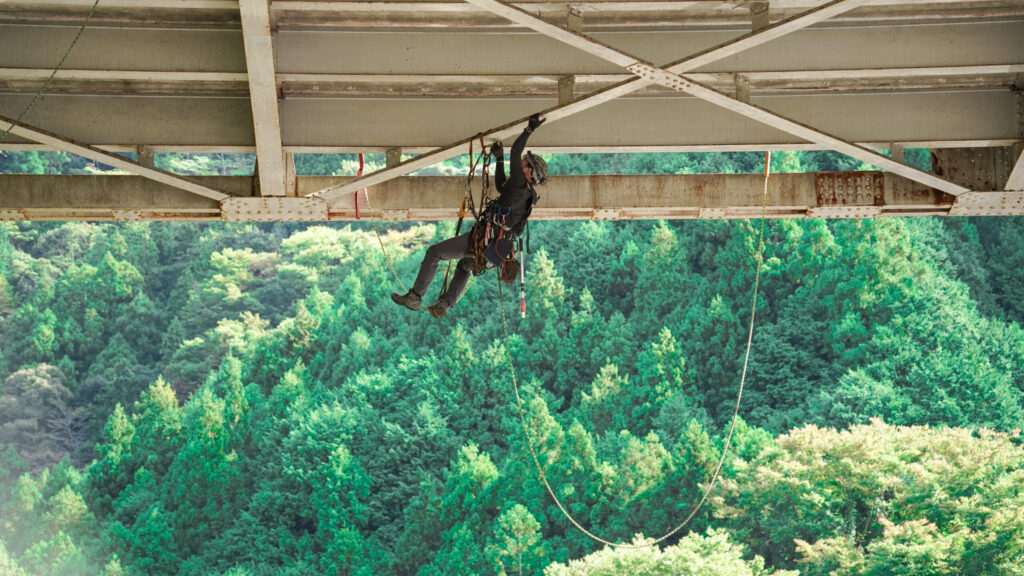
Infrastructure inspection in Japan demands an exceptionally high level of quality. It cannot be completed by simple vertical movement alone.
In bridge inspection, for example, accessing the underside of a bridge requires lateral movement, which in turn necessitates the establishment of multiple anchor points. Naturally, there are also sites where scaffolding is erected, or where bridge inspection vehicles with elevating platforms are used.
However, site conditions vary considerably, and the same method cannot always be applied universally. The access method is therefore selected according to the conditions of each individual site.
Rope access is one such option and SORAT is the method capable of meeting Japan’s demanding infrastructure inspection standards.
Japan is one of the most seismically active countries in the world. In response to this reality, road structures in Japan are built with unique seismic design specifications, which in turn adds considerable complexity to inspection work.
The fatal ceiling collapse at the Sasago Tunnel in 2012 served as a catalyst for a major overhaul of road structure maintenance and management systems. As a result, periodic close-visual inspections of road structures including bridges were made mandatory nationwide on a five-year cycle, and a framework for the early detection of damage was established.
Specific examples of the structure involved include: fall-prevention systems designed to keep bridge girders from dropping during seismic events; lateral force distribution systems that disperse horizontal seismic forces across multiple piers; bearing supports positioned between pier caps and girders; and level-difference prevention systems designed to eliminate road surface discontinuities following an earthquake these and other diverse ancillary structures are densely concentrated in the space beneath bridge decks.
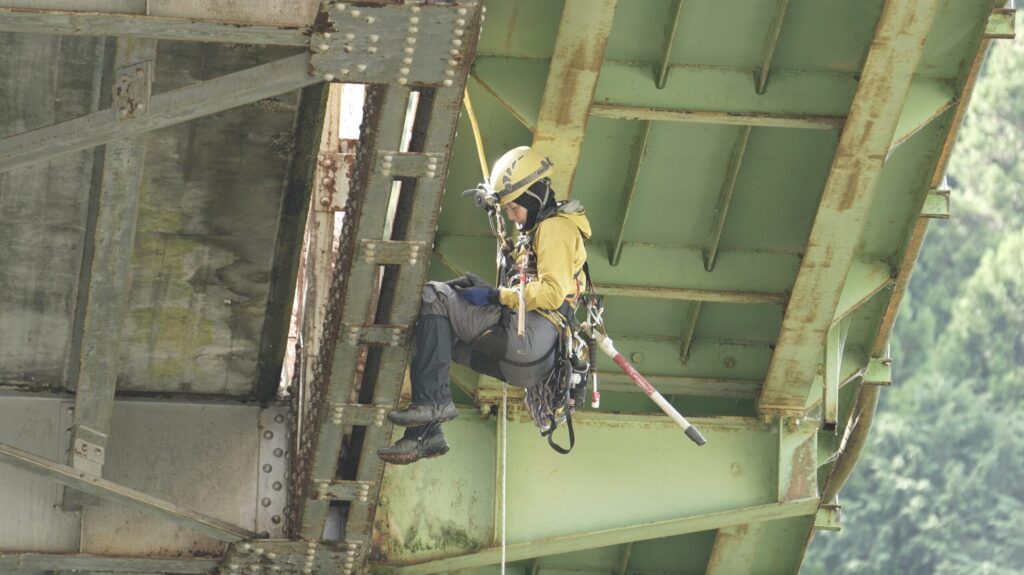
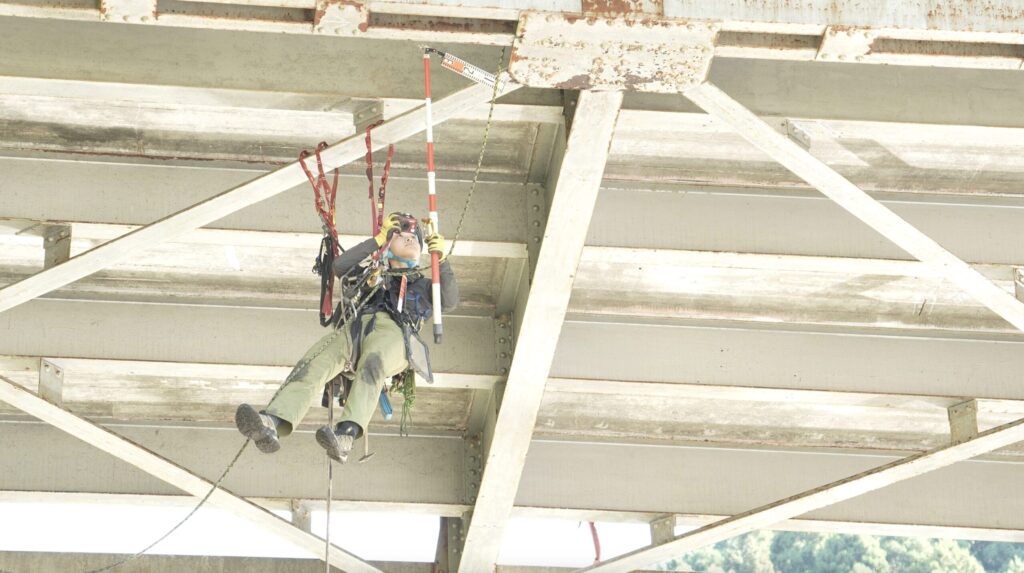
The 2016 Kumamoto Earthquake caused the collapse of bridges that had incorporated a specialized rocking pier design. This event prompted a renewed examination of seismic design philosophy and the safety of existing bridges, subsequently leading to the advancement of seismic retrofitting and safety review initiatives for bridges across the country.
Each time such accidents and disasters occur and lessons are accumulated, bridge structures become increasingly sophisticated. As a result, the space beneath bridge decks becomes ever more complex.
Inspection engineers must navigate through these structures, performing close-visual inspections for damage, corrosion, and cracking. Numerous locations cannot be reached by simple vertical movement alone. This is precisely why three-dimensional movement is indispensable in bridge inspection in Japan.
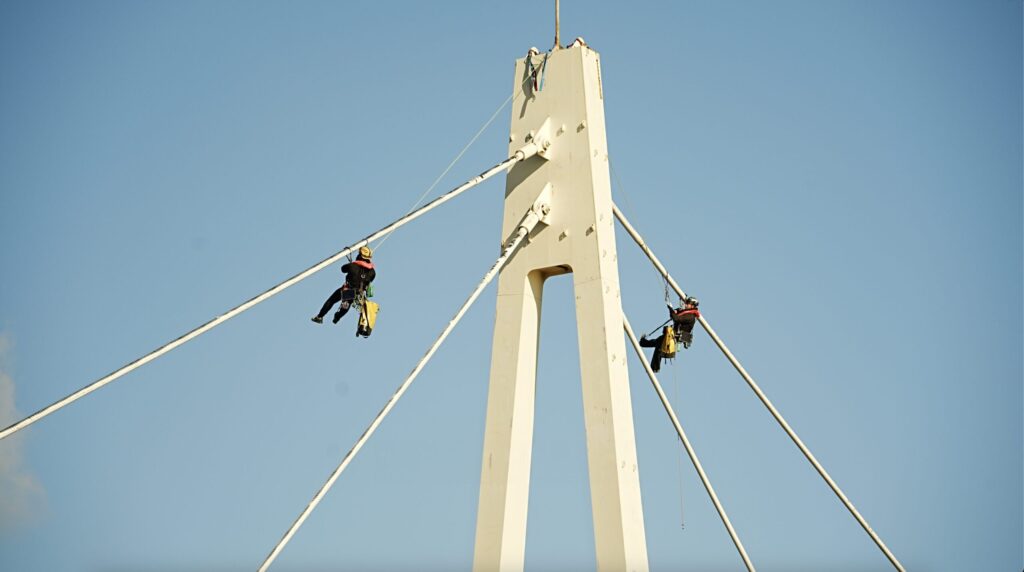
There is an internationally widespread rope access technical framework known as IRATA, which is premised on the use of two ropes. We do not intend to dismiss or discredit that system.
However, in the three-dimensional movement required within the space beneath Japanese bridges where seismic structures are densely concentrated and the environment is intricately layered in three-dimensions. The greater the complexity of the rope and anchor point management becomes, the higher the risk of human error.
Regardless of the methods, complexity is a source of risk. That is a universal principle in safety engineering. SORAT was developed to resolve that complexity through a method tailored to Japanese field conditions.
So how does SORAT resolve this complexity? The answer lies in the concept of “1 rope, 2 or more anchor points.” This approach aligns remarkably well with the structural conditions encountered at Japanese infrastructure inspection sites, including bridge inspections.
① The Fundamental Principle of Two-Point Security
In SORAT, a minimum of two anchor points are maintained at all times. In the event that security at one anchor point is lost, the other remains, preventing a fall. During movement, a new anchor point is first established in the direction of travel, creating a temporary three-points then releasing the original anchor point later.
This approach enables free three-dimensional movement through the complex space beneath bridge decks, where fall-prevention systems and bearing supports are densely concentrated while maintaining safety at all times. By increasing the number of anchor points, both safety and mobility are achieved simultaneously.
②Operational Check
The correct functioning of descenders and ascenders is verified without exception prior to the commencement of any work. No operation is initiated until the proper function of all equipment has been confirmed.
③Pre-load Test
The load-bearing capacity of anchor points is verified in advance to ensure safe operations. By applying an actual load to confirm the integrity of fixed structures, the risk of anchor point failure is reduced to near zero. This test proves effective even for fixed structures with complex geometries that are difficult to assess visually, such as seismic retrofitting structures on bridges.
The foundation of SORAT’s safety assurance is executing the 3 principles without exception. And for 35 years since our founding, we have maintained a zero-accident record. This is the most compelling evidence of the soundness of SORAT’s design philosophy.
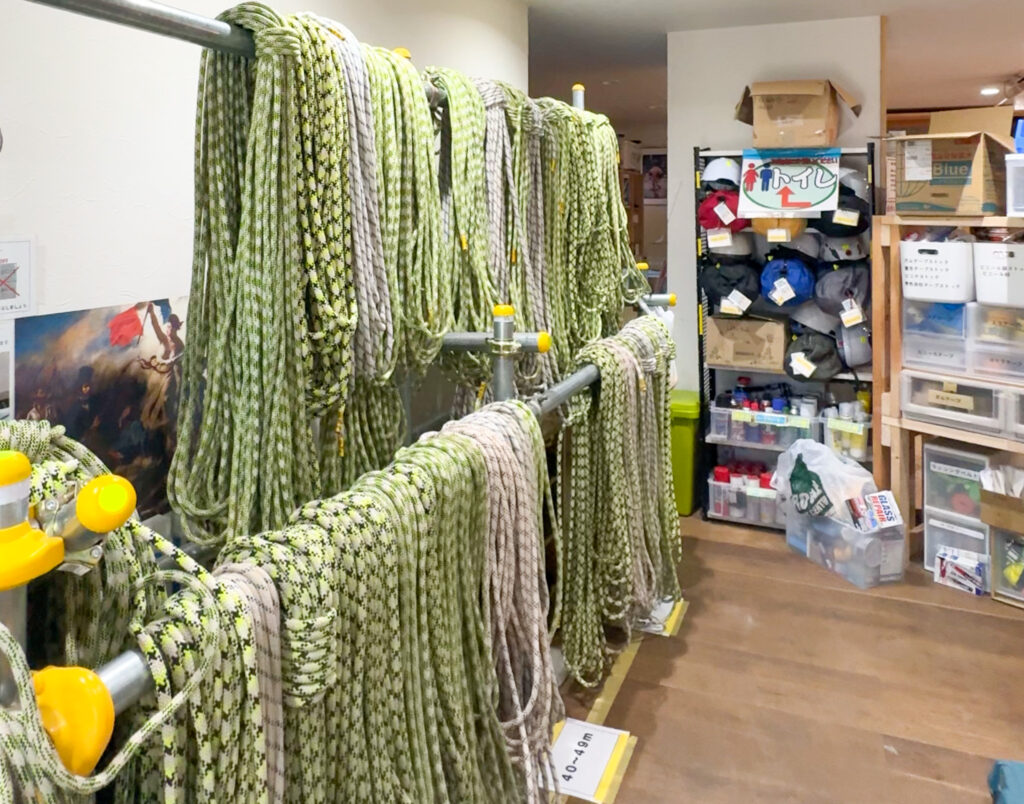
A backup rope is meaningless unless the rope itself is in perfect condition. No matter how many ropes are added, if their quality cannot be guaranteed, they are nothing more than decoration.
Ropes do not break easily. Their rated load capacity exceeds 2 tonnes, and operational procedures are strictly enforced to prevent contact with external surfaces. Furthermore, SORAT mandates rigorous rope quality management.
Before and after every operation, the full length of each rope is inspected both its outer surface and internal condition and any rope that has exceeded a designated service period is retired, without waiting for performance degradation to become apparent.
Maintaining quality equivalent to that of a new rope at all times is an absolute requirement.Stepping on a rope or handling it carelessly is entirely unacceptable.
Treating the rope with respect in all day-to-day handling as the very instrument to which one entrusts one’s life is the fundamental attitude expected to every SORAT technician.
The same standard applies to fixed structures. A pre-load test is conducted in advance, and ropes are secured to a minimum of two structurally sound fixed points. This reduces risk to the lowest possible level.
A single rope guaranteed to be in perfect condition is safer than multiple ropes of uncertain quality. Maintaining every rope at the highest quality equivalent to a brand-new rope is the most powerful form of backup.
“Isn’t the use of a single rope a violation of the law” This is a point frequently raised on social media. The answer is NO.
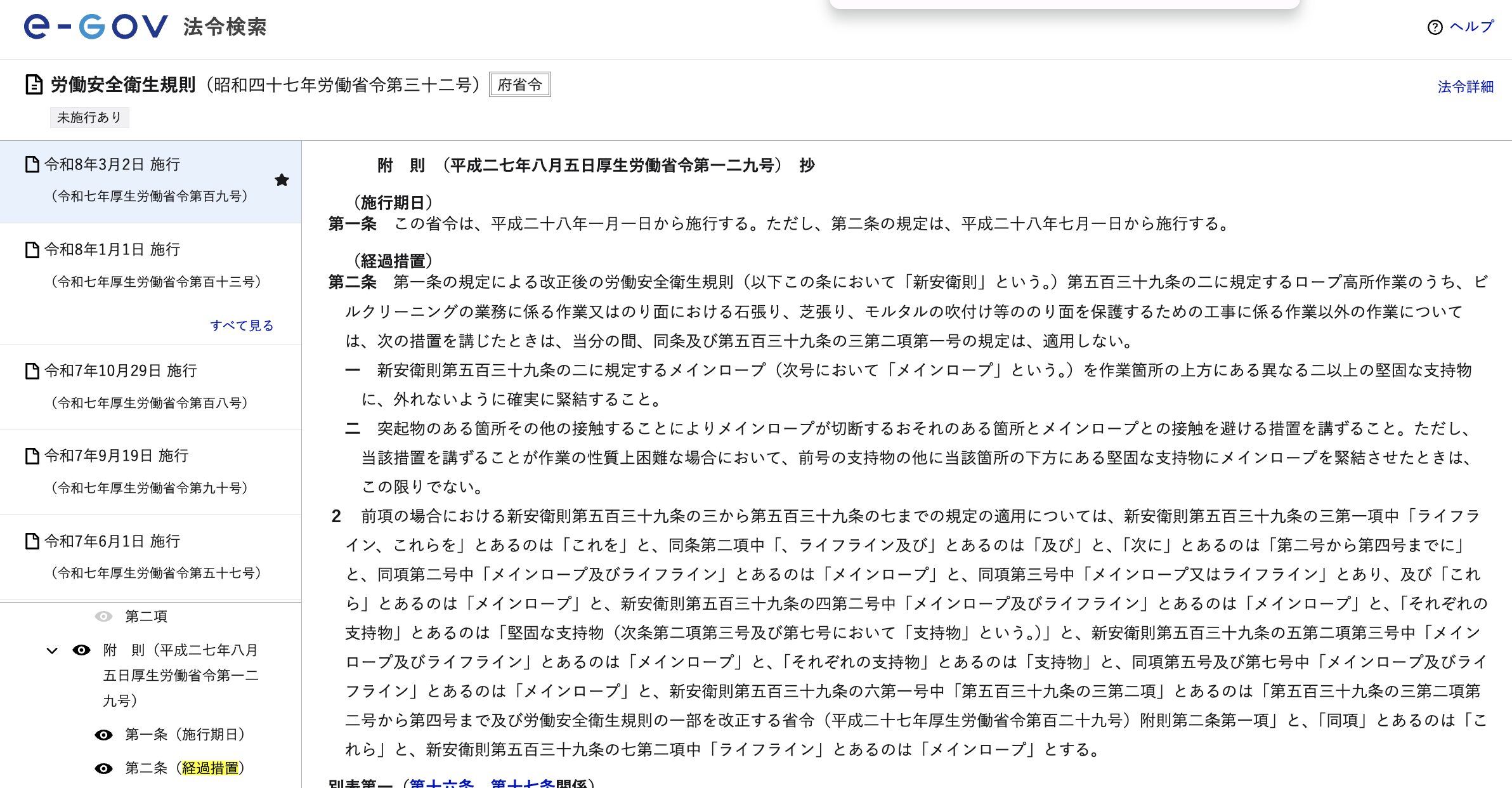
Under the supplement provisions of Japan’s Industrial Safety and health regulations (安全衛生規則), the use of a single rope is officially permitted, provided that the rope is securely fixed and measures are taken to prevent severance caused by contact with external surfaces.
This is a method developed in accordance with the realities of Japanese infrastructure worksites, and one that has been formally authorized both legally and technically.
(Relevant legislation links and informational leaflets are available here.)
Supplementary Provisions to the ordinance on Industrial Safety and Health 労働安全衛生規則附則 (Ministry of Health, Labour and Welfare Ordinance 厚生労働省令 No. 129 of 2015)
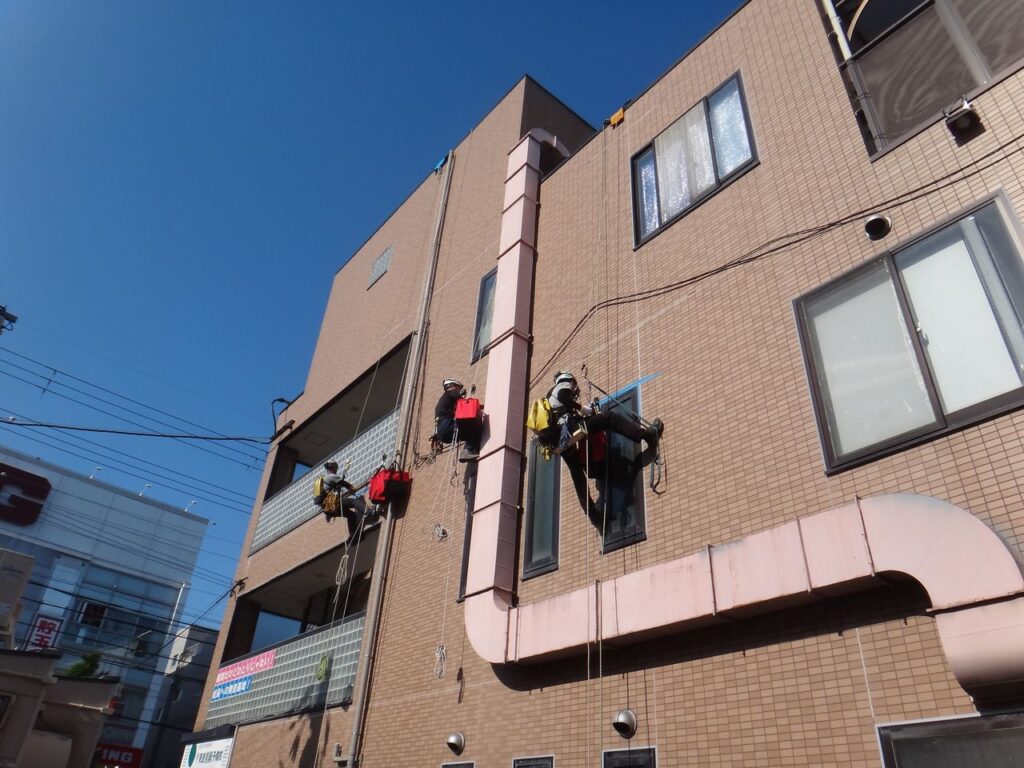
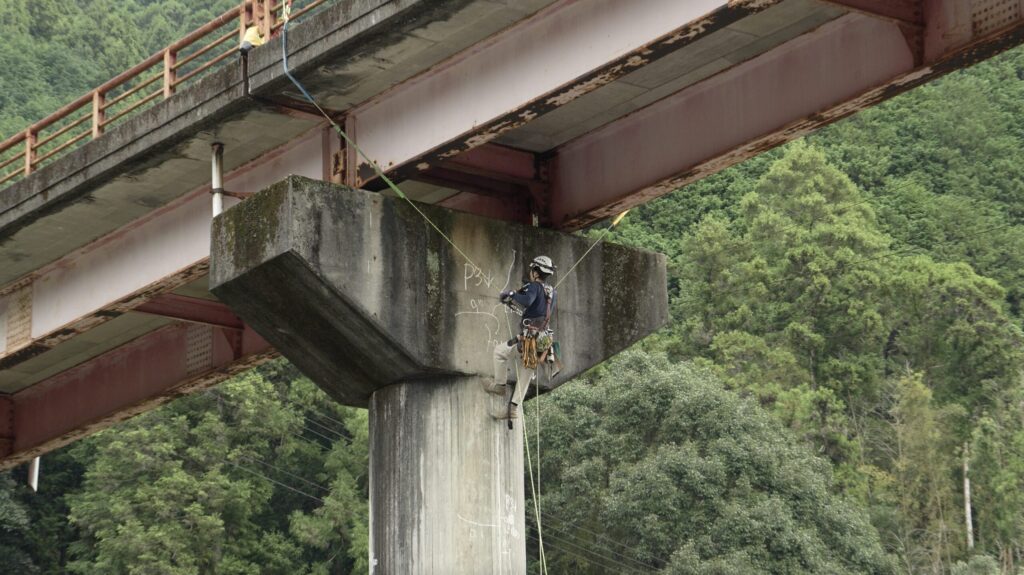
We are not rigidly committed to the use of a single rope.
When a comprehensive assessment determines that there is a risk of rope severance such as during the use of power tools or in high-wind conditions, 2 ropes are employed. Client requests are of course accommodated as well. In exterior facade worksites, 2-rope configurations are frequently used.
In addition, we actively utilize a technique known as “V-rig”, which makes use of 2 ropes. Selecting the most appropriate method for each individual site is our fundamental approach.
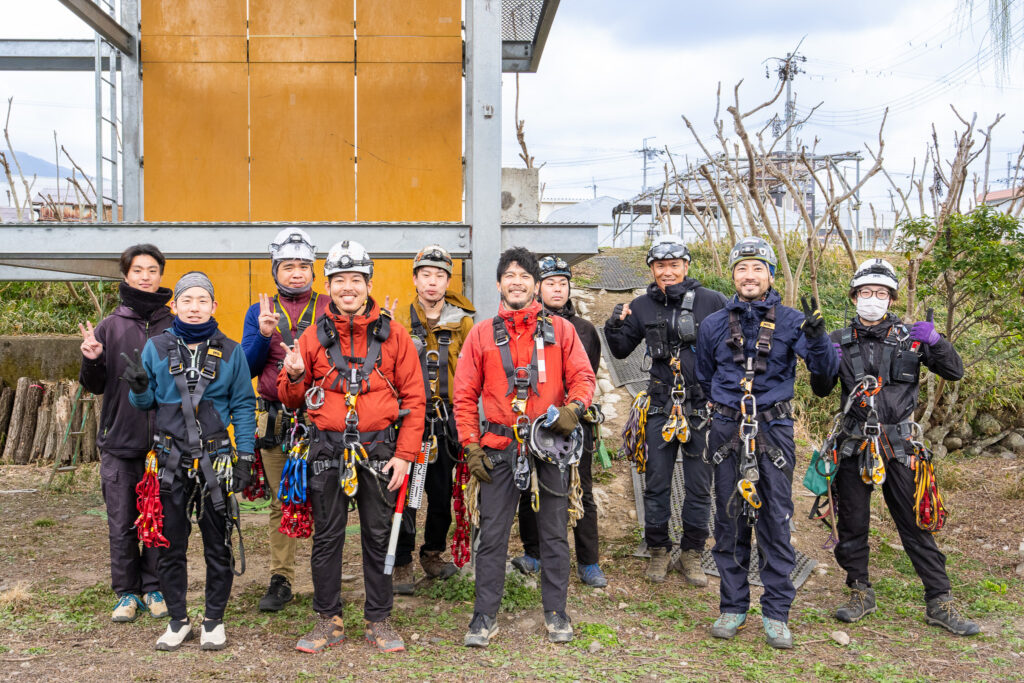
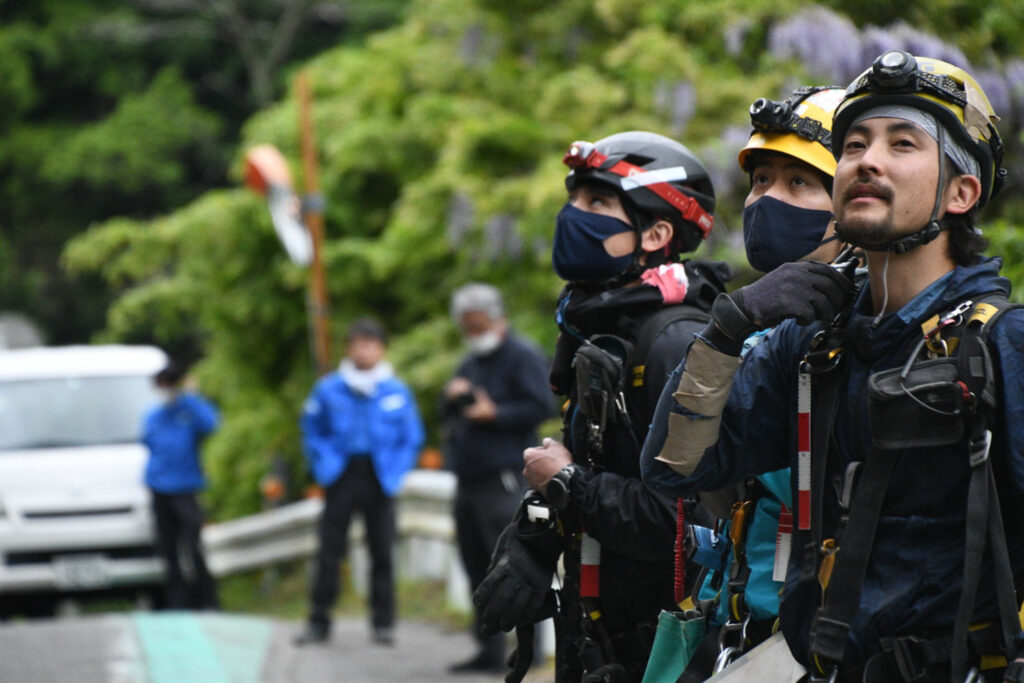
SORAT operates under a rigorous technical certification system. Only those who have completed the prescribed training programme and passed the required examinations are authorised to conduct rope-based field operations. Every member of our team holds this certification.
Many individuals have attempted to obtain this qualification, and not all have succeeded. The reason we maintain such a high standard is rooted in our belief that it is the competence of the technician themselves that ultimately guarantees safety.
Some who view our videos and posts may feel that the techniques look achievable. However, what is shown on screen is the work of certified professionals who have undergone extensive training and rigorous assessment, carried out under thorough preoperative verification procedures.
The apparent simplicity of what is seen is itself proof of SORAT’s advanced level of expertise. The reason it appears easy is that the technique is highly refined not because it is something anyone can replicate.
Attempting the same operations without certification or training is an act of serious fatally risk. Under no circumstances should anyone attempt to replicate what is shown in our videos on their own.
Before debating the merits of a single rope, the question that must be asked is the quality of the person handling that rope. SORAT makes no compromises in this regard.
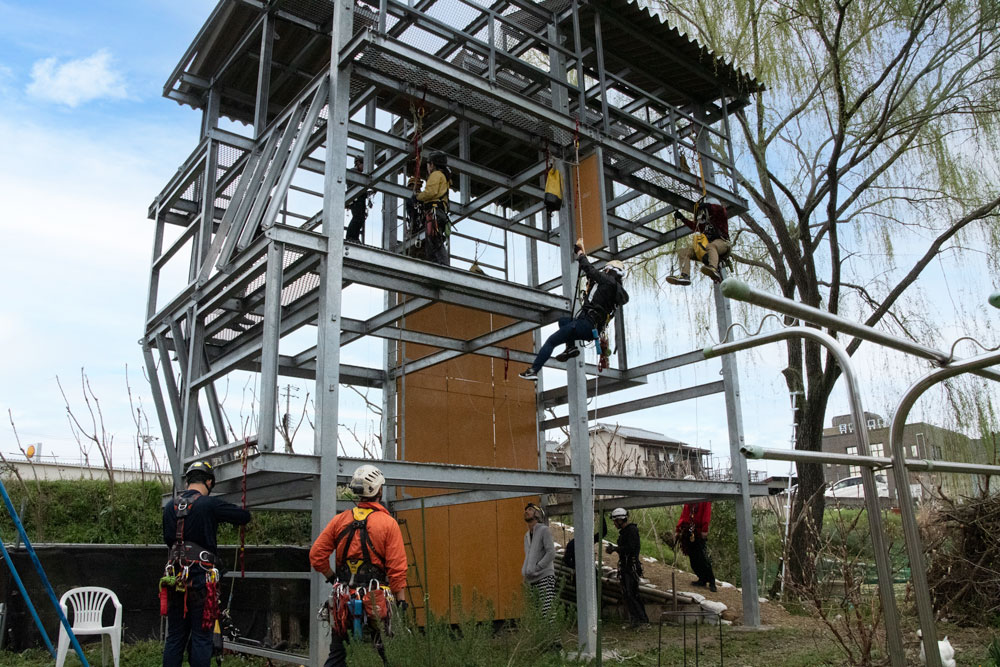
We are not in any way dismissing other rope access techniques. For vertically oriented access operations, the 2-rope method is an excellent approach.
However, infrastructure inspection in Japan presents a worksite with fundamentally different challenges. SORAT is a technique designed to resolve problems that genuinely exist in Japanese field conditions.
We pursue both safety and inspection quality without compromise.
The commitment to safety is universal.
Stay safe today.